

News & Insights
Photo courtesy of: Greg Land

Why procurement is becoming a strategic priority for higher education leaders
For much of the past decade, higher education institutions have focused their sustainability efforts on the emissions they directly control. Campuses have invested in energy-efficient buildings, renewable energy, fleet electrification, and utility infrastructure improvements. As a result, many institutions have made meaningful progress in reducing Scope 1 and Scope 2 emissions.
As that work advances, attention is increasingly turning to a different challenge: understanding the environmental impact of the products and services institutions purchase every day.
This shift is often discussed through the lens of Scope 3 purchased goods and services (PGS) greenhouse gas emissions. But the real story is not emissions accounting. It is the growing importance of procurement as a strategic function that influences sustainability, resilience, operational performance, and long-term institutional outcomes.
WHAT THIS MEANS: Purchased goods and services have always carried environmental impacts. What has changed is our ability to better understand and evaluate them. For many colleges and universities, purchased goods and services represent one of the largest remaining sources of greenhouse gas emissions, creating new opportunities to align procurement decisions with broader institutional priorities.
For procurement leaders, this represents an important evolution. Cost, quality, and service will always matter, but institutions are increasingly asking additional questions: How do purchasing decisions support climate commitments? What environmental impacts do they have? How do they reduce risk? How do they strengthen supply chain resilience? How do they contribute to long-term operational goals?
The institutions making the most progress are not treating sustainability as a separate initiative. They are incorporating it into existing procurement processes, supplier relationships, and decision-making frameworks.
Institutions that view procurement as a strategic lever rather than an administrative function will be best positioned to advance sustainability, financial, and operational objectives simultaneously.
A directional baseline is often enough to identify priorities and begin making progress.
A relatively small number of purchasing categories frequently account for a disproportionate share of emissions and offer the greatest opportunity for impact.
The highest-emitting category is not always the best place to start. Focus first on areas where contracts, supplier relationships, and operational realities create opportunities for meaningful near-term progress.
Many vendors are already investing in emissions reduction, reporting, and product innovation. Institutions that engage suppliers strategically can accelerate progress while strengthening relationships across their supply chains.
Cost savings, resilience, operational efficiency, and risk mitigation often resonate across a broader range of stakeholders. The strongest initiatives advance multiple objectives at the same time.
Ultimately, the institutions best positioned for long-term success will be those that recognize procurement as an increasingly important component of campus sustainability. Building the capability to understand, prioritize, and act on procurement-related emissions today will help institutions meet not only their climate commitments, but also their broader operational and strategic goals in the years ahead.
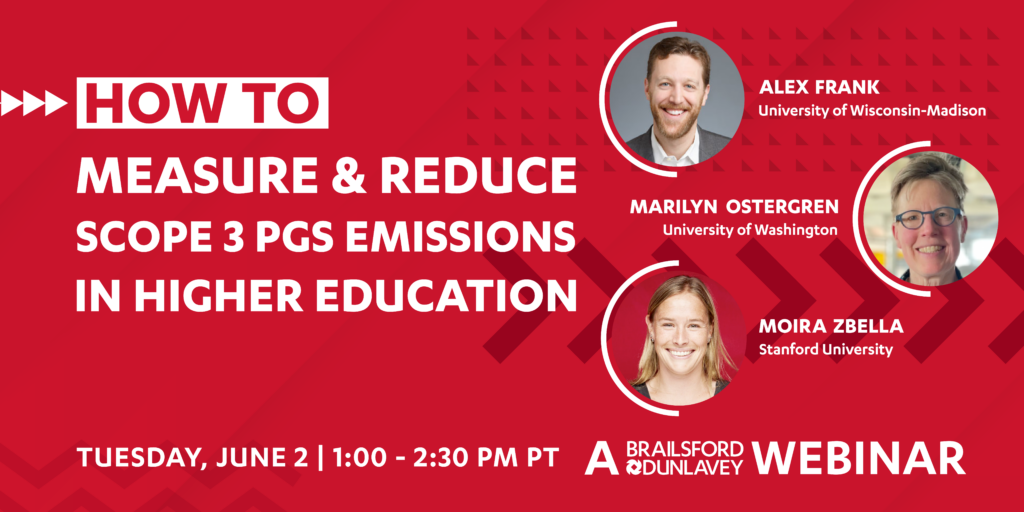
If you’re interested in how institutions are approaching Scope 3 purchased goods and services emissions in practice, I encourage you to watch B&D’s recent webinar, “How to Measure & Reduce Scope 3 PGS Emissions in Higher Education.” Featuring sustainability and procurement leaders from Stanford University, the University of Washington, and the University of Wisconsin–Madison, the discussion explores practical approaches for identifying emissions hotspots, prioritizing action, engaging suppliers, and making progress without waiting for perfect data. It’s a valuable next step for institutions looking to translate sustainability goals into actionable procurement strategies.
Kevin Laycock is an Associate in Brailsford & Dunlavey’s Infrastructure, Energy & Sustainability practice. With more than 15 years of experience advising colleges and universities, he specializes in strategic energy planning, greenhouse gas inventory management, carbon mitigation strategies, climate action planning, and campus infrastructure improvement. Kevin works with higher education institutions nationwide to help align sustainability goals with operational, financial, and long-term institutional priorities. He can be reached at klaycock@bdconnect.com.


