

Why organizations need an engagement scale to guide their strategy
Across major capital and community-impact projects, communications and engagement are often discussed as essential but are rarely defined with enough precision to guide real decision-making. Many teams recognize the need to “keep stakeholders informed,” yet struggle to articulate what that should look like at different moments in a project’s lifecycle. The result is misalignment—internally or with the client—that leads to inconsistent outreach, mismatched expectations, and missed opportunities for meaningful participation.
A more intentional approach begins with clarity: identifying whom the project needs to reach, what level of involvement is appropriate, and how different communication methods can support the project’s broader goals. A structured communications and engagement scale provides a practical way to create that clarity.
A framework for intentional, not improvised, engagement
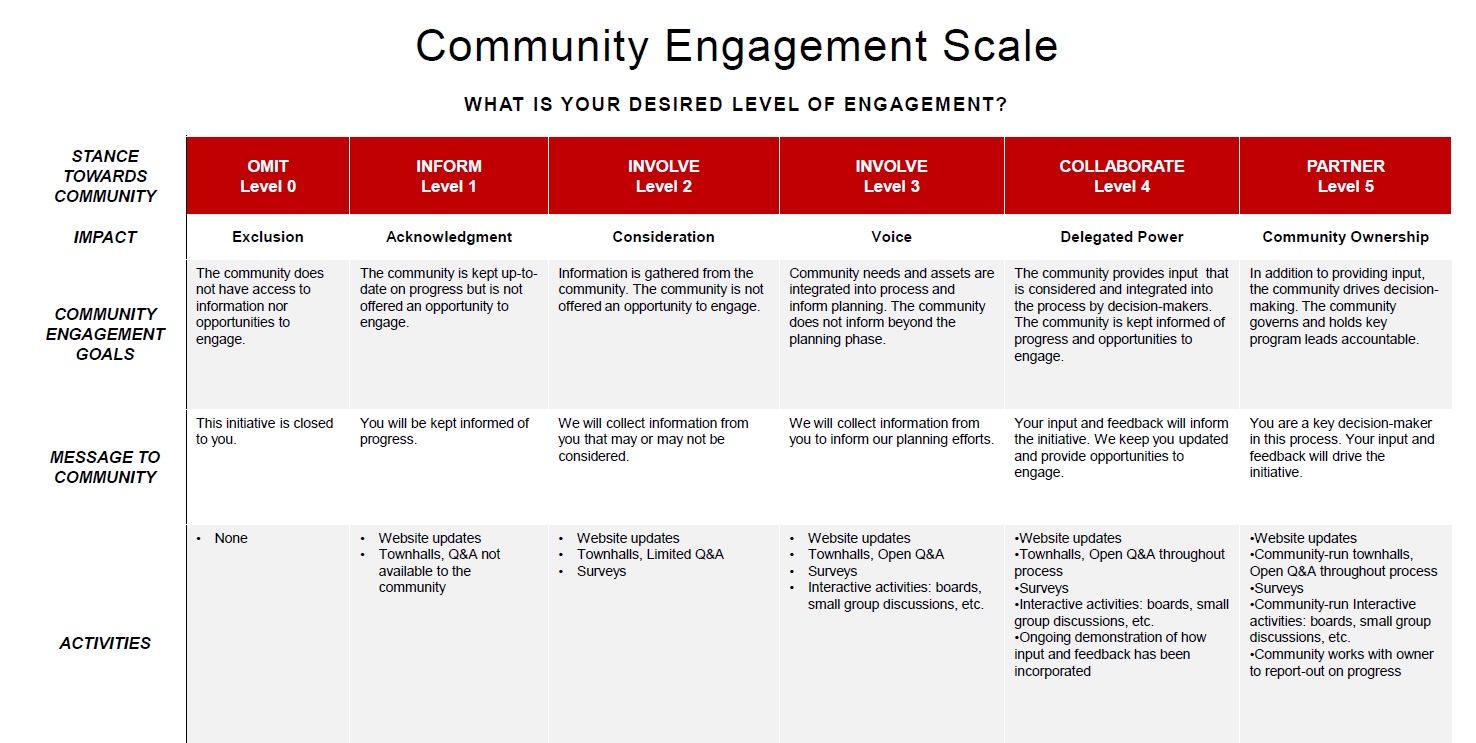
A communications and engagement scale establishes shared language around levels of involvement—from basic information sharing to full decision-making partnerships. Importantly, it does not prescribe a “right” level of engagement. Instead, it illustrates a continuum of choices and encourages teams to think critically about what each level means in practice.
This structured view benefits project teams in several ways:
By grounding communication decisions in an intentional scale, teams shift from improvisation to strategy.
Why visualization improves decision-making
Presenting all engagement levels simultaneously—rather than offering isolated options—enables more effective client dialogue. The side-by-side view highlights how different approaches shape the stakeholder experience and what trade-offs each entail. This allows teams and clients to compare, debate, and ultimately select approaches that align with the project’s values, risks, and constraints.
Consider a new sports venue proposed in a rapidly growing neighborhood. Early assumptions might suggest that certain groups, such as homeowners’ associations, require only periodic updates. But when the engagement scale makes visible the distinction between “inform” and “consult,” the team may recognize that structured opportunities for input could prevent misinformation, elevate local insights, and reduce downstream conflict. The scale does not dictate that consultation is mandatory—it simply broadens the conversation, so the implications are clear.
This holistic view encourages clients to move beyond minimal compliance and toward engagement choices that genuinely support project success.
Building shared responsibility and more resilient strategies
Projects frequently experience tension between what a client feels comfortable communicating, what a community expects, and what the project team believes is necessary. The engagement scale offers a neutral tool to navigate those tensions. It creates space for open dialogue about preferences, constraints, and goals—without anchoring the conversation in subjective opinions or ad hoc decisions.
When used effectively, the scale helps teams:
Ultimately, the scale supports a more transparent and collaborative planning process. It helps ensure that engagement is not just an obligation, but a deliberate strategy that strengthens relationships, mitigates risk, and improves outcomes for both clients and communities.
Robert Nelson, Jr. is a communications and public engagement manager at B&D supporting the Prince George’s County Public School Capital Programs and Blueprint Schools program. He brings more than ten years of experience managing communications and engagement for nonprofit organizations in higher education and education companies, along with strong skills in graphic design, video editing, and marketing. He holds a BA in communications from Keystone College and an MA in professional and organizational communications from Regis College. Rob can be reached at rnelson@bdconnect.com.


